Believe it or not, this is a thing, and even a sport, officially. Button football is here to stay.
Showing posts with label buttons. Show all posts
Saturday, 3 December 2022
Thursday, 17 October 2019
How to choose the right buttons for your garment
Although this may sound rather straightforward to some, choosing what button to use with your garment may be a difficult decision. Whether you are swapping them on a purchased garment, or one you are making yourself, there are a few things you should bear in mind. Especially, if, like me, you love vintage buttons and wish to use some of those (like from your granny's box).
To start with, it is important to remember, that the size of the button counts in its diameter, as well as it thickness. Then, there are flat, or sew-through buttons and buttons with shanks. The latter can be very beautiful, but cannot be machine-sewn. Obviously, there are lots of different materials to choose from, and finally, the finish, as some buttons may have rough surface and turn out unsuitable for certain fabrics.
Wednesday, 13 June 2018
Plexi glass / Lucite buttons - Glass imitation from early 20th century
There were a lot of kinds of early plastics, as experiments with synthetic materials continued. Plexi glass was an attempt to imitate glass, both transparent and opaque.
Monday, 14 May 2018
Sticky button cards
Throughout the whole 20th century buttons were displayed and distributed on button cards. I have some lovely Art Deco cards from 1930s, but also some more modern ones from 1960s. The buttons were usually sewn to the cards. I once met a woman who was delighted to see my button cards because they reminded her of her youth: she used to live in Paris, where she sewed the buttons to the cards for a large fashion firm.
Anyway, somewhere around 1950s-1960s someone had one of those 'brilliant' ideas to make things easier and instead of sewing - glue the buttons to the cards, usually using an adhesive tape. I saw this method used all through the 1970s and 1980s!!
Apparently, this looks easier. You spent much less time attatching the buttons to the display and if you rip them off, you do not let the rest of the buttons loose (which was the case of sewn cards).
Anyway, somewhere around 1950s-1960s someone had one of those 'brilliant' ideas to make things easier and instead of sewing - glue the buttons to the cards, usually using an adhesive tape. I saw this method used all through the 1970s and 1980s!!
Apparently, this looks easier. You spent much less time attatching the buttons to the display and if you rip them off, you do not let the rest of the buttons loose (which was the case of sewn cards).
Thursday, 25 January 2018
Swapping buttons - winter coat makover
Have you ever owned one of those? Sad black coat, with little character or decoration? You probably still do, beacuse they seem to be universal, but in the end, they just make a silent existence in our wardrobes. I decided to give mine a new life.
As you can see, it is a classic short coat, with a hood, double breasted and with a belt. The buttons are really unexciting and just make it more classic. I bought it in times when I would go everywhere on a bicycle, so I needed something short but warm.
Tuesday, 5 September 2017
Mother of pearl buttons and their cheap imitations
Mother of pearl buttons, also called nacre buttons, have been used long in any kind of garments In the early 20th century they were the cheap and most popular material, used in all garments, from underwear to winter coats. Nowadays they are popularly used in cardigans, but sometimes also in blouses and dresses.
![]() |
| The light pink buttons are still available in my etsy shop |
Sunday, 4 June 2017
Sewing with vintage buttons
As you probably know, I am a sewist myself and the original purpose was to make garments using the my vintage button findings. I am still into it, though I must admit there is less and less time left for sewing. Today I would like to show you a few items I made using buttons from my collection.
The first one is a retro-inspired blouse with button closure. I used two small black buttons in ball shape.
Sunday, 22 January 2017
Henri Hamm - A great button designer
Have you heard of Henri Hamm? I hadn't, until I discovered his buttons at that fantastic button exhibition in Paris. I took a picture of his name to learn more about this fascinating figure. To my surprise, there was not much about this great man on the Internet, not even a mention on Wikipedia!
When I saw this, I immediately decided to join and published a small article about him, as surely he was a great figure, worthy of an article.
Wednesday, 7 December 2016
Vegetable ivory - Vegan and eco friendly buttons from early 20th century
Although named after ivory, a controversial material from today's perspective, it has nothing to do with African wildlife. Tagua nuts come from corozo palm tree in south America. They are 100% vegetable and sustainable material, only resembling the authentic ivory in colour, hardness and the grain, which is a bit more tree-like. However, since modern plastic was introduced, they have become less and less popular.
![]() |
| Vegetable ivory buttons can be carved and dyed into small pieces of art! |
Thursday, 3 November 2016
Boot buttons
Nowadays, most footwear is designed to fasten with Velcros, zippers and snaps, some have shoelaces, and some even have parts made of elastic to minimise the fuss with fastening and unfastening. But in the olden days, especially women's boots had a row tiny buttons on metal loop shanks. They were popular until 1940s, when other closure systems became more widespread.
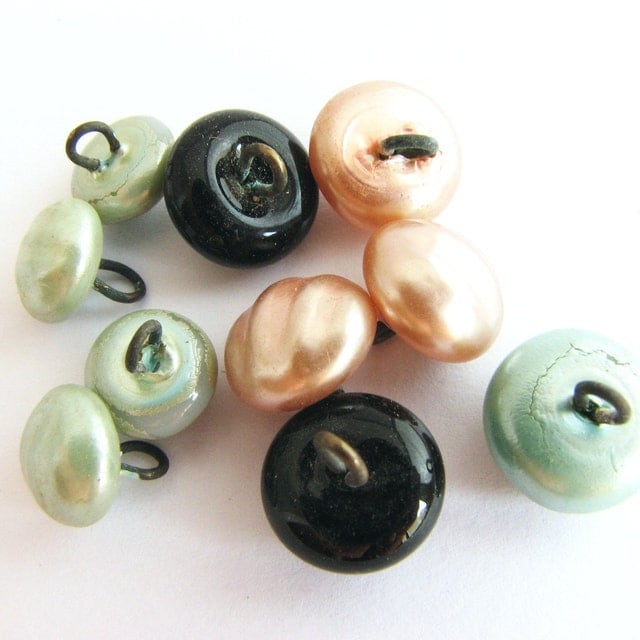
The boot buttons above are quite a luxury compared to most of the kind, made of glass and painted in beautiful colours, like mint green or pale pink. Most boot buttons, however, were made of enamelled metal, and the colours were far less exciting.
Friday, 7 October 2016
Celluloid - the indispensabe spy's equipment
Celluloid buttons were the very first I could identify among my buttons. I could clearly see they were unlike the other buttons. And I was not wrong. But first I have to explain myself why I used this unlikely title for this post. Celluloid sheets formed part of basic spy tools: as it is a highly inflammable material, these sheets helped them destroy classified information before it reached the hands of the enemy. During cold war it must have been something very common (I mean both destroying and acquiring classified information). Nowadays spying is more about hacking, so more silicon than celluloid is used in the industry. So let's get back to the buttons.
![]() |
| A range of celluloid buttons from my original collection. Some have already sold out. |
Monday, 29 August 2016
Casein - An Early Plastic
As I was cleaning my first group of buttons, I started discovering different materials. At the beginning I expected all the buttons to be simply made of plastic. I had no idea they could be any different. Of course, I could tell some were made of metal or mother of pearl, but the rest was just plastic to me.
But then, some buttons looked different. They were lighter or made a different sound when put together in a bag. Some others had uneven surface on the back. I started researching and I learnt that there are lots of other materials in the plastic family, actually, most are early kinds of plastic, which have different properties. And thanks to this information, it is also easier to date the items as made in different decades of the 20th century.
![]() |
| These buttons smelled suspicious to me... |
But then, some buttons looked different. They were lighter or made a different sound when put together in a bag. Some others had uneven surface on the back. I started researching and I learnt that there are lots of other materials in the plastic family, actually, most are early kinds of plastic, which have different properties. And thanks to this information, it is also easier to date the items as made in different decades of the 20th century.
Monday, 2 May 2016
How to machine sew a button
Although it may not seem this way, machine-sewing buttons to your garment is not only easier, faster, but also stronger. One day I had virtually five minutes to go, and just discovered that a button was missing from a coat. I found the spare one attached to the label on the lining, but I had no time to look for the needle and sew it. I decided to use the machine. It took me less than a minute (OK, I admit that I had the right thread on the machine).
I will show you how to sew a button using your sewing machine it in a few steps.
Subscribe to:
Posts (Atom)