

Showing posts with label button history. Show all posts
Showing posts with label button history. Show all posts
Saturday, 18 September 2021
Vintage buckles
You know that I'm into buckles as much as buttons. Nowadays they do not cause such a sensation as before. And no wonder. In the past they were so elaborate, so big, so colourful that you could not ignore them. Now buckles seem to have to blend with the rest of the outfit rather than stand out. That's why I absolutely love vintage buckles!


Wednesday, 13 June 2018
Plexi glass / Lucite buttons - Glass imitation from early 20th century
There were a lot of kinds of early plastics, as experiments with synthetic materials continued. Plexi glass was an attempt to imitate glass, both transparent and opaque.


Monday, 13 November 2017
War-time era buttons
The second world war was a difficult time in Europe. Although Spain was not directly involved in it (apart from some help sent to the Nazi Germany), it was no different there, as there had been a terrible civil war, which had just finished in 1939.
Along with the atrocoities came hunger and scarcity. The former moved people from cities to the countryside, where they could at least access the basic produce, and the latter was caused both by insufficiennt resources, but also by the fact that most commodities were reserved for the military use. This was the fate of the plastic, whose use was restricted for civillians.
The alternatives provided by the button manufacturers were metal and wood. However, plastic had already made it to the haberdasheries and now it was difficult to convince people to buy cheaper and more mundane materials, so the buttons were usually covered in a thick layer of paint in vivid colours, just to make them look like plastic.
Along with the atrocoities came hunger and scarcity. The former moved people from cities to the countryside, where they could at least access the basic produce, and the latter was caused both by insufficiennt resources, but also by the fact that most commodities were reserved for the military use. This was the fate of the plastic, whose use was restricted for civillians.
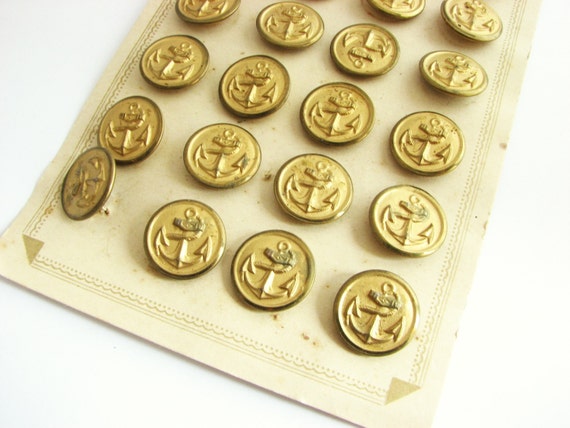 |
| This is an example of metal military buttons for the navy. |
The alternatives provided by the button manufacturers were metal and wood. However, plastic had already made it to the haberdasheries and now it was difficult to convince people to buy cheaper and more mundane materials, so the buttons were usually covered in a thick layer of paint in vivid colours, just to make them look like plastic.
Wednesday, 19 April 2017
Black glass or jet?
There is a popular misconception that 'jet' is simply black glass. However, it refers to a completely different material, which was extremely popular in Victorian times, during the queen's mourning. The fact that black glass buttons became extremely fashionable is just because they were a cheaper substitute for the genuine jet buttons worn by the queen Victoria herself after the death of her husband. Polished jet looks so similar to black glass that it is difficult to tell the difference at first. However, there are a few details that can help us tell them apart.
 |
| Tiny jet buttons |
Jet is a mineral, a stone, which means, these buttons are not cast, like glass buttons, but cut and then shaped, ground, polished etc. using some milling machinery. If they have a self shank, it is made from the same piece and is always seamless...
Sunday, 22 January 2017
Henri Hamm - A great button designer
Have you heard of Henri Hamm? I hadn't, until I discovered his buttons at that fantastic button exhibition in Paris. I took a picture of his name to learn more about this fascinating figure. To my surprise, there was not much about this great man on the Internet, not even a mention on Wikipedia!

When I saw this, I immediately decided to join and published a small article about him, as surely he was a great figure, worthy of an article.

Wednesday, 14 September 2016
Déboutonner la mode - My most treasured Book
This book is the catalogue from an exhibition I went to see while visiting Paris last year. It was a surprise visit. Our host offered to take us to Louvre, though not to see the main exhibition, but a small one, dedicated to fashion jewellery and buttons and their history. While the jewellery section, which turned out to be really small, did offer some interesting pieces, it was the button exhibition that was truly impressive!
 |
The book was also a surprise, as I got it as a gift.
Wednesday, 11 May 2016
Button Button - my first book about buttons!
When I started my button adventure, I had little idea of the immense variety of buttons, designs and materials there might be. I could date my original collection very easily, as the buttons were from an old haberdashery shop, opened circa 1958 and closed sometime between 1962 and 1963. So there is little doubt left about it. However, as I got interested in the early plastics and vegetable ivory, I decided to look for more precise information. That's how I encountered "Button Button" book.

It is not a new publication, as it was issued in 1993. As you can see, the pictures look really old, and what was new then, is already vintage today. ;) For example, 1970s buttons are referred to as modern.

It is not a new publication, as it was issued in 1993. As you can see, the pictures look really old, and what was new then, is already vintage today. ;) For example, 1970s buttons are referred to as modern.
Subscribe to:
Posts (Atom)